Table of Contents
ToggleThe Dyson V8 Absolute cordless vacuum has been around for a few years now, but it’s still selling strong. That says something. In a market flooded with stick vacuums promising the moon, this model has carved out a reputation for solid performance without the flagship price tag. But is it still competitive in 2026, or has it aged out? If you’re weighing the Dyson V8 Absolute cord free vacuum against newer models or budget alternatives, this review cuts through the marketing noise and gets into what actually matters, suction, battery life, versatility, and whether it holds up over time.
Key Takeaways
- The Dyson V8 Absolute cordless vacuum delivers solid mid-range performance with a fully sealed HEPA filtration system that captures 99.97% of particles, making it ideal for allergy and pet hair concerns.
- Runtime varies by power mode: expect up to 40 minutes in standard mode with non-motorized attachments, but only 7 minutes in max mode, making it best suited for homes under 1,500 square feet.
- At 5.75 pounds with excellent weight distribution, the V8 is maneuverable for stairs and overhead cleaning without feeling flimsy or front-heavy.
- The Dyson V8 Absolute includes versatile attachments for whole-home cleaning (direct-drive carpet head, soft roller for hard floors, mini motorized tool), eliminating the need for expensive add-ons.
- Long-term ownership costs remain reasonable at $100–$150 over five years for maintenance, with replacement batteries ($60–$80) and filters ($15–$20) readily available from Dyson and third-party suppliers.
- At $350–$400, the V8 is most valuable for apartments, condos, and homes with mixed flooring types; larger homes over 2,000 square feet may struggle with battery life management.
What Makes the Dyson V8 Absolute Stand Out
The Dyson V8 Absolute isn’t trying to reinvent the wheel. It’s a mid-tier cordless stick vacuum that delivers consistent cleaning without the premium pricing of the V11 or V15 models. What sets it apart is simplicity paired with proven engineering.
First, the filtration. The V8 uses a fully sealed HEPA filtration system that captures 99.97% of particles as small as 0.3 microns. For homeowners dealing with allergies, pet dander, or dusty renovations, that’s not a minor detail, it’s critical. The bin empties with a single lever pull, and the cyclone array does a decent job preventing clogs.
The motor spins at up to 110,000 RPM, which is slower than the newer V15 but still generates enough suction for most household messes. You’re not getting the auto-adjusting intelligence of flagship models, but you are getting a machine that works without fussing over settings. Two power modes, standard and max, give you control without overwhelming options.
Weight matters when you’re vacuuming stairs or overhead vents. The Dyson V8 Absolute cordless vacuum comes in at 5.75 pounds, which is light enough to maneuver comfortably but hefty enough to feel durable. The balance point sits near the handle, so it doesn’t feel front-heavy when extended.
It ships with a solid attachment kit: a direct-drive cleaner head for carpets, a soft roller head for hard floors, a mini motorized tool for upholstery, a combination tool, and a crevice tool. That’s more than enough for whole-home cleaning without buying extras.
Performance and Cleaning Power
Suction specs only tell half the story. Real-world performance depends on surface type, debris size, and how the cleaner head interacts with flooring.
On hardwood and tile, the soft roller head does excellent work. It picks up fine dust, cereal crumbs, and pet hair in a single pass. The roller is wide enough to cover ground quickly, and the soft bristles won’t scratch sealed floors. If you’ve got luxury vinyl plank (LVP) or engineered hardwood, this head is gentle but effective.
Carpet performance is where things get nuanced. The direct-drive head uses stiff nylon bristles to agitate carpet fibers and pull up embedded dirt. On low-pile and medium-pile carpet, it performs well, especially in standard mode. On high-pile or shag carpet, you’ll want to switch to max mode for deeper cleaning. Independent testing from sources like CNET’s Dyson V8 review confirms strong pickup rates on both carpet and hard floors, though it won’t match the raw power of plug-in uprights.
Pet hair is a common pain point. The V8 handles it without drama. The mini motorized tool is particularly effective on furniture, stairs, and car interiors. The direct-drive head doesn’t tangle easily, but long hair will eventually wrap around the roller bar. Plan to cut it free every few weeks with scissors.
One thing to note: the V8 doesn’t have a display or sensors to tell you when suction drops. You’ll need to visually check the bin and filter. It’s old-school, but it keeps the price down and reduces repair complexity.
Battery Life and Runtime Considerations
Battery life is where cordless vacuums live or die, and the V8 offers a reasonable but not revolutionary runtime.
In standard mode, you’ll get about 40 minutes of runtime with a non-motorized attachment (like the crevice tool). Drop that to around 25-30 minutes with a motorized head attached, since the brush motor draws extra power. That’s enough for most single-story homes or apartments under 1,500 square feet.
Switch to max mode and runtime drops to about 7 minutes. That’s not a typo. Max mode is designed for spot cleaning or stubborn messes, not whole-home runs. If you’ve got a tracked-in mud situation or a spill on carpet, max mode will handle it, but plan accordingly.
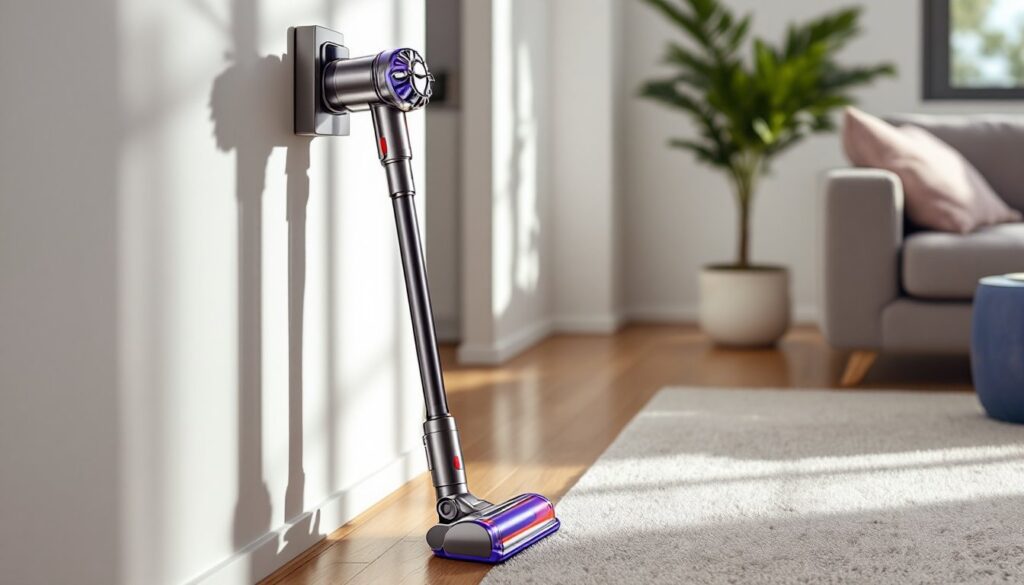
The battery is integrated, which means you can’t swap in a spare. Charging takes around 5 hours from empty to full using the wall-mounted dock. That’s slower than some newer models with fast-charge tech, but it’s fine if you charge overnight.
For larger homes or multi-story layouts, the V8 requires a bit of strategy. Vacuum high-traffic areas first, then recharge before tackling bedrooms or less-used spaces. It’s not a dealbreaker, but homeowners with 2,000+ square feet might find themselves splitting cleaning sessions.
Battery degradation is real. Lithium-ion cells lose capacity over time, and Dyson’s batteries are no exception. Expect noticeable decline after 2-3 years of regular use. Replacement batteries are available but run around $60-$80, so factor that into long-term ownership costs.
Versatility and Attachments for Every Surface
A vacuum’s only as useful as its ability to clean what you actually own. The V8 Absolute ships with enough tools to handle most surfaces without buying add-ons.
The direct-drive cleaner head is the workhorse for carpets and rugs. The motorized roller uses stiff bristles to dig into fibers, pulling up dirt that non-motorized heads miss. It’s about 10 inches wide, so coverage is decent but not as fast as a full-size upright.
The soft roller head is purpose-built for hard floors. The large, felted roller captures fine dust and debris without scattering it. If you’ve ever used a vacuum that just pushes dust around on hardwood, you’ll appreciate the difference.
The mini motorized tool is a standout. It’s designed for upholstery, but it’s equally effective on car seats, pet beds, and stairs. The rotating brush bar lifts embedded hair and crumbs, and the compact size makes it easy to maneuver. Testing from Good Housekeeping’s Dyson V8 review highlights its effectiveness on upholstery and tight spaces.
The combination tool does double duty with a brush attachment that flips down for dusting. Use it on baseboards, windowsills, and trim work. It’s not fancy, but it works.
The crevice tool is your go-to for tight spots: couch crevices, radiator fins, window tracks. It’s about 10 inches long, long enough to reach but not so long it becomes unwieldy.
One limitation: the V8 doesn’t convert into a true handheld mode as seamlessly as some competitors. You’ll always have the wand attached, which can feel awkward when cleaning above shoulder height. For overhead vents or ceiling corners, it’s manageable but not ideal.
Maintenance and Long-Term Ownership Costs
Dyson vacuums are engineered to last, but they’re not maintenance-free. Understanding upkeep helps avoid surprise costs down the line.
Filter maintenance is straightforward. The pre-motor filter and post-motor filter should be rinsed under cold water once a month. Let them air-dry completely, at least 24 hours, before reinstalling. Don’t skip this. A clogged filter kills suction and strains the motor. Filters should be replaced every 12 months, and Dyson sells them for around $15-$20.
Bin and cyclone cleaning is less frequent but still necessary. Every few months, wipe down the clear bin and cyclone shroud with a damp cloth to remove dust buildup. Fine particles can cake onto the cyclone vanes, reducing efficiency.
Brush bar maintenance is where most DIYers run into trouble. Hair, string, and carpet fibers wrap around the roller bar. On the direct-drive head, you’ll need to remove the end cap (a coin works for the screw) and cut away tangled debris. Do this every 4-6 weeks if you have long hair or pets. The soft roller head is easier, just wipe it clean.
Battery replacement is the big-ticket item. As mentioned earlier, battery life degrades over time. A replacement runs $60-$80, and installation is straightforward, two screws and a connector clip. That’s reasonable compared to buying a new vacuum, but it’s a cost to plan for.
One advantage: Dyson’s parts availability. Even for older models, you can source filters, brush bars, and batteries directly from Dyson or third-party suppliers. That’s not true for every brand, and it extends the vacuum’s usable life.
No belts to replace, no bags to buy. That’s a cost saver over time, especially compared to traditional uprights. Over five years, you’re looking at maybe $100-$150 in maintenance if you’re diligent, filters, a battery, and maybe a replacement brush bar.
Who Should Buy the Dyson V8 Absolute
The V8 Absolute isn’t for everyone, but it fits specific use cases well.
Best for: Homeowners with 1,000-1,500 square feet, a mix of hard floors and low-to-medium pile carpet, and a need for quick daily cleanups. If you’ve got pets and allergies, the HEPA filtration and motorized tools make a strong case.
Also good for: Apartment dwellers or condo owners who don’t have room for a plug-in upright. The wall-mounted dock keeps everything organized, and the cordless design means no outlet hunting.
Not ideal for: Large homes over 2,000 square feet where runtime becomes a limiting factor. If you’re vacuuming multiple levels or have a lot of high-pile carpet, you’ll spend more time managing battery life than cleaning.
Skip it if: You need the absolute latest tech. The V8 lacks the LCD screen, auto-adjusting suction, and laser dust detection found on newer models. It also doesn’t have the anti-tangle comb found on the V15. For those features, you’ll need to step up (and spend more).
Pricing sits around $350-$400 depending on sales, which positions it as a mid-range option. That’s competitive with brands like Shark and Tineco, but you’re paying for Dyson’s motor tech and build quality. According to insights from Popular Mechanics, Dyson’s engineering and repairability still set a benchmark in the cordless vacuum category.
If you’re upgrading from a budget stick vacuum or an old plug-in, the V8 will feel like a significant step up. If you already own a V10 or V11, the differences aren’t compelling enough to justify a sidegrade.
Conclusion
The Dyson V8 Absolute isn’t flashy, and it’s not the newest model on the shelf. But it’s a well-built, dependable cordless vacuum that handles everyday messes without drama. For homes under 1,500 square feet with a mix of flooring types, it’s a practical choice that balances performance, cost, and long-term serviceability. Just go in with realistic expectations about runtime and maintenance.