Table of Contents
ToggleShopping for a new laundry set can feel like navigating a maze of drum capacities, cycle options, and price points. But if durability and no-nonsense performance top your list, Maytag has earned its reputation for building machines that keep running year after year. Whether you’re replacing a worn-out pair or setting up a laundry room from scratch, a Maytag washer and dryer set offers straightforward operation, solid construction, and features that tackle real-world loads, from muddy work clothes to pet hair-covered bedding. This guide walks through what makes Maytag a practical choice, which models suit different households, and how to plan your installation so the set fits your space and your budget.
Key Takeaways
- A Maytag washer and dryer set combines commercial-grade durability with a 10-year limited warranty on core components, making it a cost-effective choice for households running multiple weekly loads.
- Front-load models spin at 1,200 RPM to extract up to 20% more water than top-loaders, reducing dryer time by 15–25 minutes per load and lowering energy costs.
- Top-load Maytag sets offer faster cycle times (under 30 minutes) and easier access without bending, while front-loaders provide better efficiency and stackability for compact laundry spaces.
- Moisture sensors and steam functions prevent over-drying, fabric damage, and energy waste, making these features worth prioritizing in mid-tier and premium models.
- Proper installation requires 29 inches of width and 39 inches of depth per appliance, a 240V circuit for electric dryers, and dryer vents under 25 feet with rigid metal ducting for safety.
- Maytag washer and dryer set prices range from $1,400 for entry-level top-loaders to $3,200+ for premium front-loaders with pet-specific filters and Wi-Fi connectivity.
Why Choose a Maytag Washer and Dryer Set for Your Home?
Maytag built its name on commercial-grade durability, and that engineering trickles down to residential models. The brand’s washers use a PowerWash cycle with extra cleaning action and higher spin speeds to extract more water, cutting dryer time. The dryers feature a Wrinkle Prevent option and moisture sensors that stop the cycle once clothes hit the target dryness level, saving energy and reducing wear on fabrics.
Buying a matched set, rather than mixing brands, simplifies installation. Width, depth, and utility hookups align, so you won’t discover mid-install that your dryer vent sits two inches too low for the washer’s drain hose. Aesthetically, washer and dryer Maytag pairs share control panels, finish options, and stacking kits (if you go vertical). That consistency matters when resale value or a cohesive laundry room look is on your radar.
Maytag also backs its machines with a 10-year limited parts warranty on the wash basket and drum, one of the longest in the industry. That’s a signal the company expects the core components to outlast the typical seven-to-twelve-year appliance lifespan. For households running multiple loads per week, families with kids, pet owners, or anyone who works outdoors, that extra warranty coverage translates to fewer repair calls and lower lifetime cost of ownership.
Top Maytag Washer and Dryer Set Models to Consider in 2026
Maytag’s 2026 lineup spans entry-level agitator models to high-efficiency front-loaders. Here’s a snapshot of configurations that fit common homeowner needs:
MVW6230HW / MED6230HW (Top-Load Agitator Set)
This top-loading Maytag washer and dryer duo uses a traditional agitator, which some users prefer for tackling heavily soiled work clothes. The 4.7 cu. ft. washer capacity handles king-size comforters, and the dryer’s hamper door design lets you toss in last-minute socks without opening the main drum. Expect a retail price around $1,400–$1,600 for the pair. It’s a solid pick if you want straightforward controls, turn the dial, press start, without touch screens or Wi-Fi.
MVW7232HW / MED7230HW (Top-Load Impeller Set)
Swap the agitator for an impeller, and you gain interior space, this Maytag top load washer and dryer set offers 5.3 cu. ft. in the washer. The impeller’s low-profile design reduces fabric tangling and uses less water per cycle. The matching dryer includes a steam refresh option to knock out wrinkles between washes. Budget $1,700–$1,900 for the set. It’s a step up in efficiency without the learning curve of front-load machines.
MHW6630HW / MED6630HW (Front-Load Set)
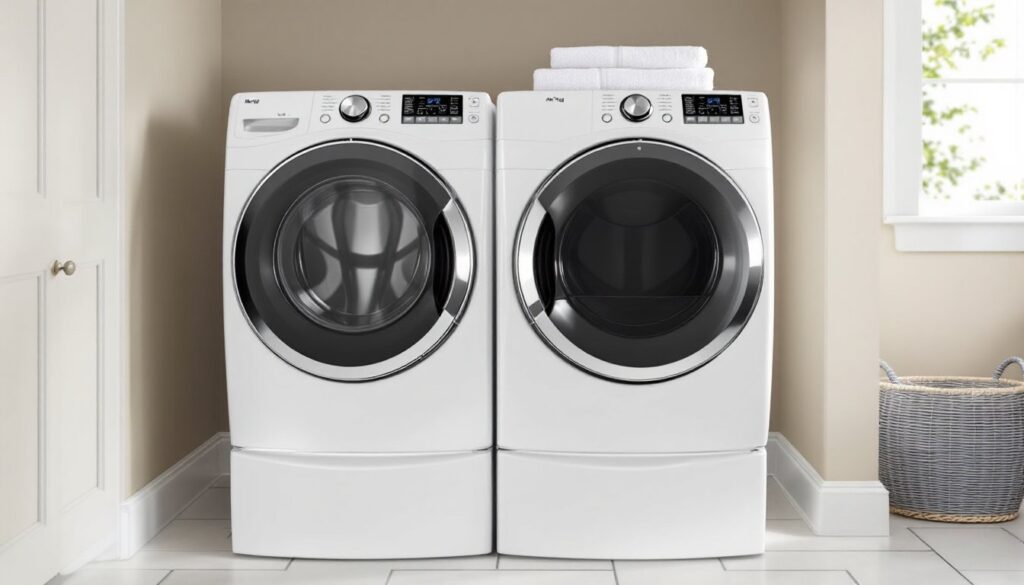
For maximum efficiency and cleaning power, this Maytag washer and dryer front load set delivers. The 5.0 cu. ft. washer spins at 1,200 RPM, extracting up to 20% more water than comparable top-loaders. The dryer’s advanced moisture sensing adjusts heat in real time, cutting energy use. Both units feature stackable design compatibility and offer a sleek fingerprint-resistant finish. Pricing typically lands between $2,200–$2,600. Front-loaders do require bending to load and unload unless you install pedestals (add $250–$400 for the pair).
MHW8630HW / MED8630HW (Front-Load with Pet Pro Filter)
If you own dogs or cats, the Pet Pro System in this set is worth the premium. The washer’s extra filter traps pet hair before it clogs the drain pump, and the dryer’s pet hair removal cycle uses steam and extended tumbling to loosen fur from fabrics. Capacity mirrors the standard front-load set (5.0 cu. ft. washer, 7.3 cu. ft. dryer), but you’ll pay closer to $2,800–$3,200. This configuration earned recognition in washer and dryer testing for its ability to handle heavy shedding breeds.
Front-Load vs. Top-Load Maytag Sets
Front-Load Advantages:
- Higher spin speeds mean shorter dryer cycles (save 15–25 minutes per load)
- Gentler on fabrics due to tumble action instead of agitator friction
- Stackable configuration for tight laundry closets (units typically 27″ W × 39″ D × 39″ H stacked)
- Qualifies for ENERGY STAR ratings more easily, lowering utility bills
Top-Load Advantages:
- No bending required, easier on backs and knees
- Faster cycle times on many models (some finish in under 30 minutes)
- Can add items mid-cycle without draining the tub
- Lower upfront cost (entry models start $400–$500 less than front-loaders)
Neither design is “better”, it depends on your laundry room layout, physical needs, and how you prioritize efficiency versus convenience. If your home has a second-floor laundry closet with limited floor space, a washer dryer Maytag front-load set that stacks vertically may be the only viable option. For a basement laundry room with plenty of square footage, a set Maytag washer and dryer in top-load configuration offers speed and ease of use.
Key Features to Look for in a Maytag Laundry Set
When comparing models, focus on features that match your household’s actual laundry habits. Gimmicks fade: utility endures.
Capacity and Load Size
A 4.5–5.0 cu. ft. washer handles a queen-size comforter and two pillows in one load. If you regularly wash king-size bedding or have a family of five or more, step up to 5.3 cu. ft. or larger. Dryer capacity should roughly match, most Maytag dryers range from 7.0 to 7.4 cu. ft. Undersized dryers force you to split washer loads, wasting time and energy.
Spin Speed (RPM)
Higher spin speeds extract more water, reducing dryer time and energy consumption. Maytag top-loaders typically spin at 700–900 RPM: front-loaders hit 1,100–1,200 RPM. That 300 RPM difference can shave 20 minutes off a dryer cycle. If you pay for electricity by the kilowatt-hour, faster spins pay for themselves over the appliance’s lifespan.
Moisture Sensors
Dryers without sensors run on timed cycles, which either over-dry (damaging fabrics and hiking energy bills) or under-dry (forcing you to restart). Maytag’s IntelliDry sensor measures exhaust temperature and humidity, adjusting heat and cycle length automatically. Look for models with this feature, it’s standard on mid-tier and premium sets.
Wash Cycles and Options
Basic sets offer 8–10 cycles (Normal, Heavy Duty, Delicates, etc.). Premium models add specialty cycles like Sanitize (kills 99.9% of bacteria using high heat), Allergen (extra rinse to remove detergent residue), and Quick Wash (cleans lightly soiled items in 15–20 minutes). If anyone in your household has sensitive skin or allergies, the extra rinse cycle is worth prioritizing.
Steam Functions
Steam in the washer penetrates fabric fibers to loosen stains without pre-soaking. Steam in the dryer refreshes wrinkled clothes or sanitizes items that can’t be washed (throw pillows, stuffed animals). It’s a nice-to-have, not a must-have, but if you iron dress shirts weekly, the dryer’s steam refresh can eliminate half that chore.
Vibration Reduction
Maytag uses Advanced Vibration Control in its front-loaders, which adjusts spin speed if the load becomes unbalanced. Top-loaders rely on auto-sensing suspension systems. If your laundry room sits above living spaces or shares a wall with a bedroom, quieter operation matters. Front-loaders generally produce 50–55 dB during spin: top-loaders hit 60–65 dB. For context, 60 dB equals conversational speech, 50 dB resembles a quiet office.
Installation and Space Requirements for Your Laundry Room
Measure twice, order once. A washer and dryer set Maytag won’t function properly if it doesn’t fit the room or if utilities aren’t positioned correctly.
Clearances and Dimensions
Most Maytag washers and dryers measure 27″ W × 30–33″ D × 38–41″ H (dimensions vary slightly by model). Add 1 inch on each side for airflow and vibration clearance, 6 inches behind for hoses and venting, and 1 inch in front so doors can open fully. That means you need a minimum space of 29″ W × 39″ D per appliance. If you’re stacking, verify ceiling height, stacked units with pedestals can reach 80 inches.
Electrical and Plumbing Requirements
Washers need a 120V, 15-amp circuit and hot/cold water supply lines (standard ½” or ¾” connections). Dryers split into two camps: electric models require a 240V, 30-amp circuit (four-prong or three-prong outlet, depending on local code), while gas dryers need a 120V outlet plus a natural gas or propane hookup. If you’re converting from gas to electric (or vice versa), budget $300–$800 for an electrician or plumber to run new lines. Some jurisdictions require permits for 240V circuits: check local code before you start.
Venting the Dryer
Electric and gas dryers both exhaust moist air through a 4-inch rigid or flexible duct. Keep vent runs under 25 feet total length: every 90° elbow subtracts 5 feet of effective length. Use rigid metal duct instead of flexible foil or plastic, it resists lint buildup and meets most fire codes. Vent terminations must sit at least 12 inches above grade and 3 feet from windows or doors. If your laundry room has no exterior wall, consider a condensing dryer (rare in Maytag’s lineup) or hire a contractor to route ductwork through an attic or crawl space.
Water Heater Considerations
Maytag washers default to a warm or hot wash for many cycles. If your household runs multiple appliances simultaneously (dishwasher, shower, washing machine), a 40-gallon water heater may struggle to keep up. A tankless unit or a larger 50-gallon tank solves the problem. For more guidance on managing utility demands during home upgrades, homeowner maintenance checklists cover seasonal system checks.
Stacking vs. Side-by-Side
Stacking saves floor space but makes the dryer controls harder to reach, fine for occasional use, less ideal if you’re 5’4″ and running laundry daily. Maytag sells dedicated stacking kits ($50–$100) that secure the dryer to the washer and prevent shifting. DIY installation takes 30–45 minutes with a helper: you’ll need a socket wrench and level. Side-by-side placement offers easier access and lets you fold clothes on top of the machines, but requires at least 54 inches of wall width.
Pricing, Warranty, and Where to Buy Maytag Sets
Maytag pricing reflects build quality and feature sets. Entry-level top-loaders start around $700 per appliance: premium front-loaders with Wi-Fi and specialty cycles can hit $1,600 each.
Price Ranges by Category
- Budget Top-Load Sets: $1,400–$1,600 (agitator or basic impeller, 8–10 cycles)
- Mid-Tier Top-Load Sets: $1,700–$2,000 (larger capacity, steam options, extra cycles)
- Standard Front-Load Sets: $2,200–$2,600 (ENERGY STAR rated, advanced sensors)
- Premium Front-Load Sets: $2,800–$3,200 (Pet Pro filters, Wi-Fi connectivity, sanitize cycles)
Add $200–$600 if you want pedestals (raises units 12–15 inches for easier loading) and $50–$150 for extended hoses, venting kits, or anti-vibration pads. Delivery and basic hookup typically cost $100–$200: full installation (including vent routing or electrical work) runs $300–$800 depending on complexity.
Warranty Coverage
Maytag includes a one-year limited warranty on parts and labor, plus a 10-year limited warranty on the washer basket and dryer drum. Motor and transmission coverage varies by model (check the spec sheet). Third-party extended warranties from retailers add $150–$300 for 2–5 years of extra coverage, worth it if you plan to keep the set beyond 10 years or if you’re buying a model with complex electronics.
Where to Buy
Major appliance retailers (Home Depot, Lowe’s, Best Buy) stock Maytag sets year-round. Independent appliance dealers often price-match and include free delivery within a local radius. Online-only retailers (Amazon, Wayfair) sometimes undercut brick-and-mortar pricing by $100–$200, but you may sacrifice installation services. Holiday weekends (Memorial Day, Labor Day, Black Friday) bring discounts of 15–25%, if your current machines still function, waiting for a sale saves hundreds.
For design-conscious buyers planning a full laundry room refresh, curated appliance guides and remodel inspiration can help coordinate finishes (stainless, white, or the limited-edition Maytag red washer and dryer) with cabinetry and countertops.
Conclusion
A Maytag all in one washer dryer approach, whether you choose front-load efficiency or top-load convenience, delivers the kind of reliability that lets you focus on living in your home instead of babysitting appliances. Match capacity to your household size, verify your laundry room’s clearances and utilities before ordering, and prioritize features (steam, sensors, pet filters) that solve real problems. With proper installation and routine maintenance, clean the dryer vent annually, wipe door gaskets monthly, a quality set should run smoothly for a decade or more.