Table of Contents
ToggleFire ants are more than a nuisance, they’re aggressive, painful, and can turn a backyard into a no-go zone. Their mounds pop up overnight, and a single misstep can send dozens of ants swarming up a leg, stinging repeatedly. Unlike other ants, fire ants don’t just bite: they inject venom that causes burning welts lasting days. Homeowners dealing with fire ants need a clear strategy that targets both visible mounds and the hidden colonies beneath. This guide covers identification, proven treatment methods, prevention tactics, and when it’s time to bring in professional help.
Key Takeaways
- Fire ant identification starts with recognizing their reddish-brown color, size of 1/8 to 1/4 inch, and irregular dome-shaped mounds—which release aggressive ants within seconds when disturbed.
- Effective fire ant control combines broadcast baits (applied at 1 to 1.5 pounds per acre) with targeted liquid insecticide drenches that achieve 90 to 95 percent control when used together.
- Liquid or granular mound drenches work best when applied without first kicking the mound, with liquid treatments killing 85 to 95 percent of colonies within 24 to 48 hours.
- Prevention tactics including reducing moisture, maintaining a dense lawn, and creating perimeter barriers around structures significantly reduce reinfestation from neighboring fire ant colonies.
- Call a professional exterminator for heavy infestations (more than 10 to 15 mounds per quarter acre), indoor nesting, severe allergies, or when DIY methods fail after 60 to 90 days of consistent treatment.
- Reapply broadcast bait every 4 to 6 months and monitor your property every 2 to 4 weeks, as fire ants recolonize from adjacent properties and a single queen can establish a new colony in 30 to 60 days.
Identifying Fire Ants and Recognizing an Infestation
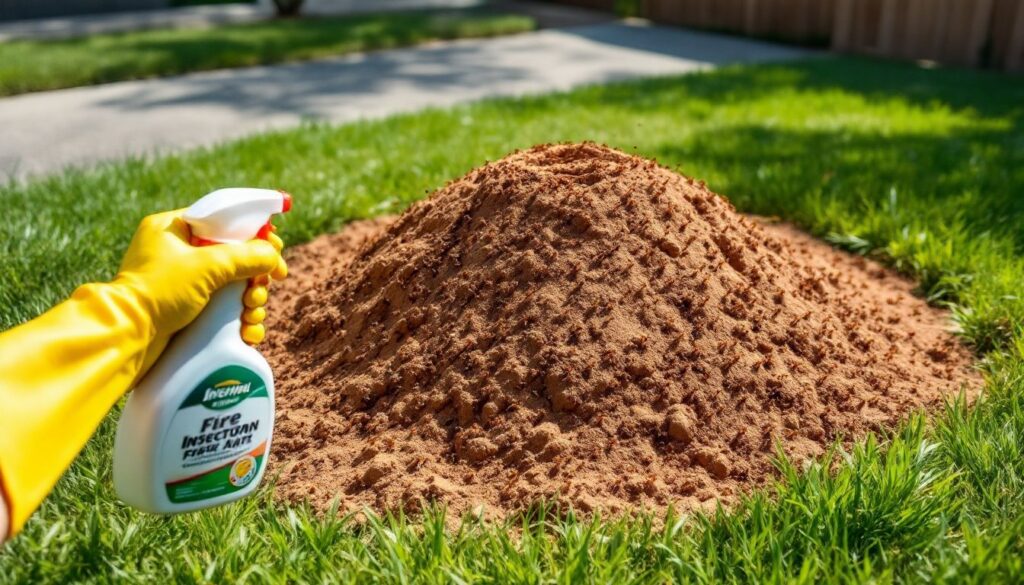
Fire ants (Solenopsis invicta) are reddish-brown to dark brown, measuring 1/8 to 1/4 inch long. Workers vary in size within the same colony, a trait called polymorphism that distinguishes them from many native ant species. Their mounds are the most obvious sign, irregular dome-shaped piles of loose, fluffy soil with no visible center hole, typically 12 to 18 inches in diameter and up to 18 inches high.
Kick a mound lightly (from a safe distance), and fire ants boil out aggressively within seconds. They climb vertical surfaces rapidly and sting in unison when disturbed. Each ant can sting multiple times, pivoting in a circle to inject venom repeatedly. The sting produces an immediate burning sensation followed by a white pustule within 24 hours.
Fire ant colonies can contain 100,000 to 500,000 workers and multiple queens. They prefer sunny, open areas, lawns, flower beds, along sidewalks and driveways, near irrigation systems, and under pavement. In cooler weather, mounds may be less visible as ants move deeper into the soil, but the colony remains active.
Check your property systematically. Walk the yard in a grid pattern, especially after rain when mounds are most visible. Look for dead patches in the lawn where mounds have smothered grass. Fire ants also invade structures, nesting in wall voids, under slabs, and around HVAC units. Indoors, they’re drawn to moisture and electrical equipment, a behavior that’s poorly understood but well-documented.
DIY Fire Ant Control Methods That Actually Work
Natural and Chemical Treatment Options
For individual mounds, mound drenches deliver immediate results. Boiling water is free and chemical-free, pour 3 gallons directly onto the mound center in the early morning or late evening when ants are most active near the surface. This method kills on contact but only works if the liquid reaches the queen(s), typically 12 to 24 inches deep. Success rate runs 60 to 70 percent for single-queen colonies.
Liquid insecticide drenches containing bifenthrin, permethrin, or carbaryl are more reliable. Mix according to label directions (typically 1 to 2 ounces per gallon) and apply 1 to 2 gallons per mound. Soak the mound thoroughly without disturbing it first, kicking it open disperses the colony and reduces effectiveness. Wear gloves, long pants, and closed-toe boots. Liquid drenches kill 85 to 95 percent of treated mounds within 24 to 48 hours.
Granular mound treatments like acephate (Orthene) work slower but are easier to apply. Sprinkle 2 to 5 tablespoons over and around each mound (avoid breathing dust), then water lightly to activate. The colony typically dies within 3 to 7 days. These products work best on mounds smaller than 12 inches.
Natural alternatives include diatomaceous earth (food-grade) and orange oil products, but field results are inconsistent. Diatomaceous earth kills individual ants through desiccation but doesn’t penetrate deep enough to reach queens reliably. Orange oil (d-limonene) requires direct contact with the colony and must be drenched like boiling water. Many gardening resources discuss organic pest control, but chemical treatments remain more effective for fire ants.
Avoid home remedies like gasoline, bleach, or dish soap. Gasoline contaminates soil and groundwater, bleach is environmentally harmful and ineffective, and dish soap rarely kills the queen.
Applying Broadcast Baits for Yard-Wide Protection
Broadcast baits are the most effective DIY strategy for yard-wide fire ant control. These granular products contain insect growth regulators (IGRs) like methoprene or pyriproxyfen, or slow-acting toxins like hydramethylnon, abamectin, or indoxacarb. Worker ants mistake the bait for food, carry it back to the colony, and feed it to the queen and brood. The colony dies over 3 to 6 weeks.
Apply bait when soil temperature is 70 to 90°F and ants are actively foraging, typically late afternoon or early evening in spring and fall. Avoid application before rain or irrigation: moisture degrades bait before ants collect it. Scatter bait evenly at 1 to 1.5 pounds per acre (about 3 to 5 ounces per 5,000 square feet) using a broadcast spreader. A handheld spreader works for smaller yards, but a push spreader gives more even coverage.
Don’t apply bait directly on mounds, fire ants recognize concentrated bait as a threat. Broadcast it across the entire treatment area so foragers encounter it naturally. Keep kids and pets off treated areas until bait is taken by ants or degraded (usually 24 to 48 hours, but check product labels).
Popular bait products include Amdro, Advion, Extinguish Plus (combines an IGR with a faster-acting toxin), and Spinosad (organic option). IGR-only baits like Extinguish or Award take longer but are safer around beneficial insects. Combination products kill faster, good for heavy infestations, but may affect non-target species.
The two-step method combines broadcast bait with individual mound treatments for stubborn colonies or high-traffic areas. Apply broadcast bait across the yard, wait 7 to 10 days, then treat any remaining active mounds with liquid or granular drench. This approach achieves 90 to 95 percent control and prevents reinfestation from neighboring colonies.
Reapply broadcast bait every 4 to 6 months. Fire ants recolonize treated areas from adjacent properties, so ongoing maintenance is essential.
Preventing Fire Ants from Returning to Your Property
Fire ant prevention starts with making your property less hospitable. Reduce moisture sources, fix leaky irrigation, improve drainage in low-lying areas, and avoid overwatering lawns. Fire ants need water, and saturated soil encourages deeper colonies that are harder to treat.
Maintain a healthy, dense lawn. Fire ants prefer open, sunny soil. Thick turf shades the ground and makes mound-building difficult. Mow at the recommended height for your grass type (3 to 4 inches for most cool-season grasses, 1 to 2 inches for Bermuda and Zoysia), and fertilize according to soil test results to promote vigorous growth.
Create physical barriers around high-priority zones. Apply a perimeter treatment of granular insecticide or bait around foundations, patios, playgrounds, and garden beds. Products containing bifenthrin, lambda-cyhalothrin, or fipronil provide residual protection for 3 to 6 months. Apply in a band 5 to 10 feet wide, following label rates. This won’t stop fire ants entirely but reduces colonies near structures.
Eliminate food sources. Fire ants are omnivores, feeding on insects, seeds, honeydew from aphids, and human food waste. Clean up pet food, secure garbage bins, and control aphid populations on ornamentals. Managing common household pests reduces the food supply that sustains fire ant colonies.
Monitor regularly. Walk your property every 2 to 4 weeks, especially in spring and fall when fire ant activity peaks. Treat new mounds immediately before colonies mature and produce winged reproductives. A single mated queen can establish a new colony in 30 to 60 days.
Coordinate with neighbors. Fire ants don’t respect property lines. If adjacent lots have untreated infestations, your yard will be recolonized continuously. Encourage neighborhood-wide treatment programs or coordinate bait applications. Some municipalities and homeowners associations offer group purchasing or professional treatment plans.
When to Call a Professional Exterminator
Call a professional if DIY methods fail after 60 to 90 days of consistent treatment. Heavy infestations, more than 10 to 15 mounds per quarter acre, often require professional-grade equipment and restricted-use pesticides not available to homeowners. Licensed exterminators have access to products like fipronil (Termidor, Taurus) and chlorfenapyr (Phantom) that provide superior residual control.
Professionals are essential when fire ants nest inside structures. Indoor colonies require targeted treatments in wall voids, under slabs, and around electrical systems. These areas are inaccessible with typical homeowner products, and improper application can spread the infestation.
If anyone in your household has a history of severe allergic reactions to insect stings, don’t risk DIY treatment. Anaphylaxis from fire ant stings is rare but potentially fatal. Professional exterminators have the training and protective equipment to treat high-risk areas safely.
Some states and municipalities regulate fire ant control, especially in quarantine zones where fire ants are invasive. Professionals understand local regulations and can apply treatments that comply with integrated pest management (IPM) requirements. Check with your local extension office or agricultural department for area-specific rules.
Expect to pay $150 to $400 for an initial professional treatment covering a typical suburban lot (quarter to half acre), with follow-up treatments running $75 to $150 quarterly. Many companies offer annual contracts with scheduled reapplications. Get multiple quotes, ask about treatment methods (broadcast bait, mound injection, perimeter treatment), and confirm warranty terms. Reputable services guarantee results and will retreat at no charge if fire ants return within the warranty period.
For comprehensive home pest management strategies, including fire ant control, professional exterminators can integrate treatment plans with other yard maintenance and pest prevention efforts.
Conclusion
Fire ant control requires patience and a multi-pronged approach. No single treatment eliminates them permanently, but combining broadcast baits, targeted mound treatments, and consistent prevention keeps populations manageable. Start with yard-wide baits for long-term suppression, treat problem mounds directly for fast relief, and monitor regularly to catch new colonies early. When infestations overwhelm DIY efforts or threaten safety, professional help is worth the investment.