Table of Contents
ToggleStaring at blank walls for eight hours a day? That’s a missed opportunity. Office wall decor isn’t just about aesthetics, it’s a functional upgrade that can reduce eye strain, boost mood, and even make long workdays feel less draining. Whether it’s a home office or a corporate cubicle, the right wall treatments turn dead space into an asset. In 2026, the line between “work” and “home” continues to blur, and people are demanding workspaces that don’t feel like holding cells. This guide walks through style choices, DIY projects, and layout strategies that actually work, no fluff, just practical steps to make those walls earn their keep.
Key Takeaways
- Office wall decor reduces visual fatigue and improves focus by providing visual interest and points of attention during long workdays.
- Strategic wall decor creates psychological boundaries in home offices and improves video call quality through sound absorption from acoustic panels and fabric hangings.
- Minimalist and modern styles use clean lines and neutral palettes, while creative and eclectic approaches combine personal pieces that tell a story for maximum impact.
- Budget-friendly DIY office wall decor projects like framing prints, building floating shelves, and creating pegboard organizers cost $10–$25 and deliver professional results.
- Proper arrangement matters: use the 57-inch rule for eye-level placement, maintain 2–4 inches between frames, and align pieces with furniture below for visual balance.
- Use heavy-duty anchors rated for your wall type (drywall, plaster, or studs) to safely hang decor, and add strategic lighting to bring texture and depth to your office space.
Why Office Wall Decor Matters More Than You Think
Empty walls create visual fatigue. The human eye naturally seeks points of interest, and when it finds none, concentration dips. Studies on workspace design show that visual variety, textures, colors, patterns, helps maintain focus over extended periods. That’s not marketing talk: it’s basic ergonomics.
Wall decor for office spaces also defines zones. In a home office that doubles as a guest room or a corner of the living room, framed art or a pegboard organizer signals “this is work territory.” It’s a psychological boundary that helps separate tasks, especially important when the commute is ten feet.
There’s also the practical angle: sound absorption. Fabric-wrapped acoustic panels, textile wall hangings, or even a dense cork board can dampen echo in hard-surfaced rooms. If video calls are part of the routine, that reduction in reverb makes a noticeable difference in audio quality.
Finally, office decor wall choices reflect professionalism. If clients or colleagues see the workspace on camera, bare drywall reads as unfinished. A curated selection of prints, shelving, or a gallery wall shows attention to detail without requiring a design degree.
Popular Office Wall Decor Styles to Match Your Work Personality
Minimalist and Modern
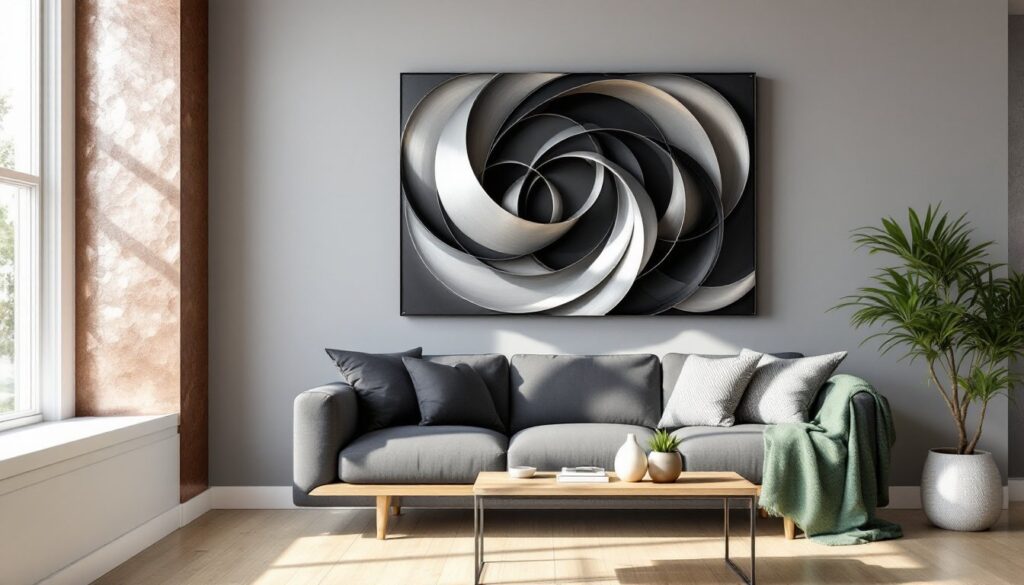
Clean lines, neutral palettes, and deliberate negative space define this approach. Think large-format black-and-white photography, metal grid panels, or floating shelves in light oak or walnut. The key is restraint: one or two statement pieces rather than a crowded arrangement.
Framed line art or abstract prints in monochrome work well here. Frames should be simple, aluminum or thin wood profiles in black, white, or natural finish. Avoid ornate molding: it clashes with the minimalist ethos.
For wall decor office setups leaning modern, consider LED backlit panels or geometric shelving. These add dimension without visual clutter. Materials like powder-coated steel, tempered glass, or matte-finish acrylics fit the aesthetic. Just make sure mounting hardware is concealed: exposed screws break the look.
Minimalist doesn’t mean cold. Incorporate texture through a single woven wall hanging, a linen-wrapped corkboard, or a plaster relief panel. These add warmth while maintaining the streamlined vibe. Platforms like modern design galleries showcase how restraint can create impact.
Creative and Eclectic
This style thrives on variety. Mix vintage posters with botanical prints, metal signs, travel photography, and dimensional objects like small shelves holding quirky finds. The unifying thread is personal relevance, each piece should have a story or spark joy, not just fill space.
Gallery walls are the go-to format here. Combine different frame styles, sizes, and finishes. Start with a 16″×20″ or 18″×24″ anchor piece, then build around it with smaller 5″×7″ and 8″×10″ frames. Lay everything out on the floor first: rearranging after hanging leaves walls full of patched holes.
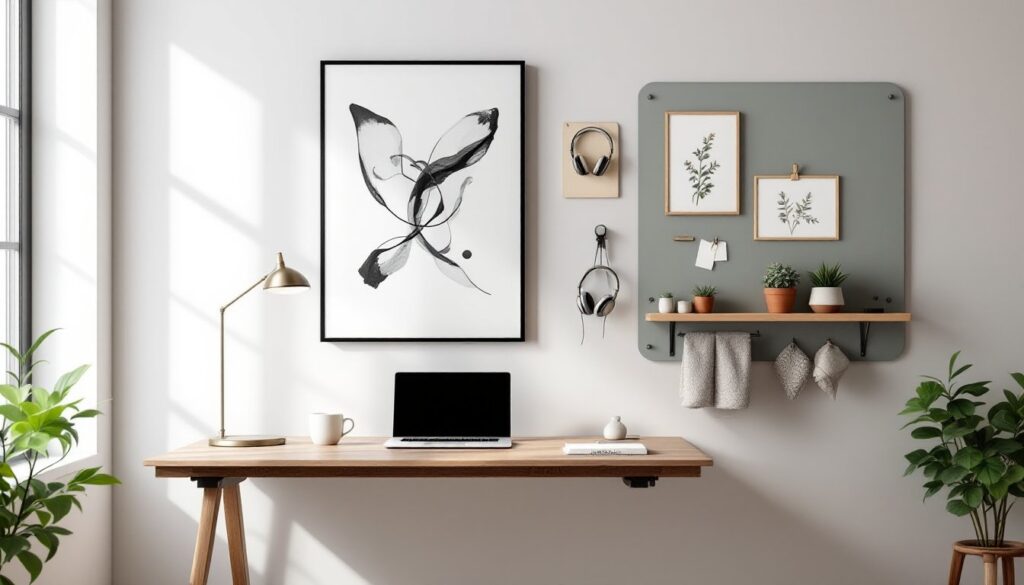
Office wall decor ideas for work in this category often include functional art: a magnetic whiteboard framed like a painting, a pegboard painted in a bold color, or a wall-mounted organizer that doubles as sculpture. These pieces earn their place by doing double duty.
Color is fair game. Don’t shy away from saturated hues, mustard yellow, deep teal, or burnt orange can energize a space. Balance brights with neutrals to avoid visual chaos. For inspiration on eclectic interiors that still feel cohesive, browse collections at creative home design hubs.
Budget-Friendly DIY Office Wall Decor Ideas
Frame your own prints. Download high-resolution art from public domain sources or print personal photography. Standard frame sizes, 8″×10″, 11″×14″, 16″×20″, cost $10–$25 at big-box stores. Mat boards add a professional touch: cut custom mats with a utility knife and metal straightedge if the pre-cut sizes don’t fit.
Build a simple floating shelf. Use 1×6 or 1×8 pine or poplar boards (actual dimensions: 0.75″×5.5″ or 0.75″×7.25″). Cut to length with a circular saw or miter saw. Sand with 120-grit then 220-grit paper, apply stain or paint, and mount with heavy-duty L-brackets or concealed floating shelf hardware rated for the load. Locate wall studs with a stud finder: drywall anchors alone won’t hold books or plants safely.
Create a pegboard organizer. A 2’×4′ sheet of ¼” tempered hardboard pegboard runs about $12. Paint it with latex primer and two coats of semi-gloss paint for a custom look. Mount it 1″ off the wall using wooden spacers (cut from scrap ¾” stock) so peg hooks fit. Attach through the spacers into studs with #8 wood screws, 2½” long. Add metal or wooden pegs to hold tools, supplies, or small planters.
Make fabric-wrapped panels. Cut ½” or 1″ rigid foam insulation board into rectangles (12″×36″ works well). Wrap with decorator fabric, pulling taut and stapling or gluing edges to the back. These double as sound-dampening acoustic panels. Mount with Command Picture Hanging Strips rated for the weight, or use small finish nails if the wall can take it.
Stencil a mural or pattern. Pick up a reusable stencil from a craft store or cut your own from Mylar sheets with a craft knife. Use low-tack painter’s tape to secure it, then apply latex paint with a foam roller or stencil brush. Work in thin coats to prevent bleed. Geometric patterns or botanical motifs add visual interest without the commitment of wallpaper. For layout ideas and techniques, DIY decor communities.
Repurpose what’s on hand. Vintage maps, sheet music, or even old blueprints frame up nicely. Clipboards mounted in a grid hold rotating art or notes. Cork tiles arranged in a pattern create both function and form. The best budget projects use what’s already available, or what can be salvaged from a previous project.
How to Arrange Wall Decor for Maximum Impact
Start with a focal point. This is typically the wall behind the desk or the one directly in the sightline when entering. A single large piece (24″×36″ or bigger) anchors the space. Alternatively, center a gallery wall or shelving unit on that wall.
Maintain visual balance. If hanging multiple pieces, aim for even visual weight. That doesn’t mean symmetry, three smaller frames on one side can balance one large frame on the other. Use painter’s tape or kraft paper templates to mock up arrangements before committing to nail holes.
Respect the 57-inch rule. Art galleries hang pieces so the center sits at 57 inches from the floor, average human eye level. In an office, adjust slightly: if the viewer is usually seated, drop the center to 48–52 inches. Measure from the floor to the desired center point, then calculate where the hanger needs to sit based on the frame’s hanging hardware.
Space pieces consistently. In a gallery wall, keep 2–4 inches between frames. Too tight feels cluttered: too loose loses cohesion. Use a level and measuring tape, not eyeball estimates. A laser level makes alignment across multiple pieces much easier.
Layer when possible. Lean smaller frames on a shelf in front of a larger piece, or overlap items slightly on a pegboard. This adds depth and makes the arrangement feel curated rather than static.
Account for furniture. Wall decor should relate to what’s below it. If there’s a desk, the decor should span roughly two-thirds to three-quarters of the desk’s width. Too narrow looks lost: too wide overwhelms.
Use proper anchors. For drywall, ribbed plastic anchors hold up to 20 lbs, toggle bolts handle 50+ lbs. For plaster walls, use self-drilling anchors or locate the wood lath behind the plaster. Always hang heavy items, mirrors, large frames, shelves, into studs when possible. Mark stud locations with light pencil marks before starting.
Light it right. If ambient light is low, add a picture light (battery-operated LED strips work) or aim an adjustable desk lamp at the wall. Shadows and highlights bring texture to life. Just avoid placing art in direct sunlight, which fades prints and photographs over time.
Conclusion
Office wall decor isn’t decoration for decoration’s sake, it’s a functional layer that improves focus, defines workspace, and makes the hours spent there more bearable. Whether going minimalist with a single statement piece or building an eclectic gallery wall, the key is intentionality. Measure twice, hang once, and don’t skip the prep work. A well-outfitted wall beats staring at paint every time.